Watch party merch planning: kitting the room before kickoff
A watch party is the least forgiving brief in live merch, and the reason is simple. There is a hard moment when everybody stops caring about your station and starts watching a screen. Everything you plan has to happen before that moment, and the moment does not move.
Your window is not your booking
The timelinePlanners routinely tell us they have a five-hour event. They do not. They have a room booked for five hours and a merch window of perhaps ninety minutes, because guests arrive on their own schedule and abandon everything at kickoff, tip-off, first pitch or puck drop.
Work backwards from the whistle. A realistic shape for an evening watch party looks like this:
- Crew load-in and buildbefore doors
- Soft open, station live15–20 min pre-doors
- Doors — steady arrivalsthe easy stretch
- Peak rush45–20 min before start
- Last ticket called~10 min before start
- Quiet lane through the first halfstragglers only
- Second, smaller pushhalf time or interval
Two things fall out of that shape. The soft open is free capacity — opening a quarter of an hour before your advertised door time costs nothing and flattens the rush, because early arrivals are the easiest guests you will serve all night. And the interval is real: staff for it, and do not let anyone start packing at kickoff.
Where the station goes in the room
Guest flowThe temptation is to put the station somewhere with a good view of the screens. Do not. Anything that puts a queue between guests and the broadcast creates a low-level irritation all evening, and the crew ends up apologising for standing in front of the thing everyone came for.
Three placements work. Near the entrance, so guests hit it while they are still in arrival mode and before they have claimed a seat. Adjacent to the bar, because a line beside a line is normal. Or in a defined side zone with its own route, which is best in a big room and the only option that really works if you run a second station too.
Whichever you choose, define the queue direction rather than leaving it to chance. A line that forms across a traffic path gets broken up by staff all night. A line with stanchions and an obvious front does not, and it looks intentional in photographs.
Keep the handover point separate from intake if the room allows. Guests collecting a finished jersey should not have to push back through the people waiting to order one.
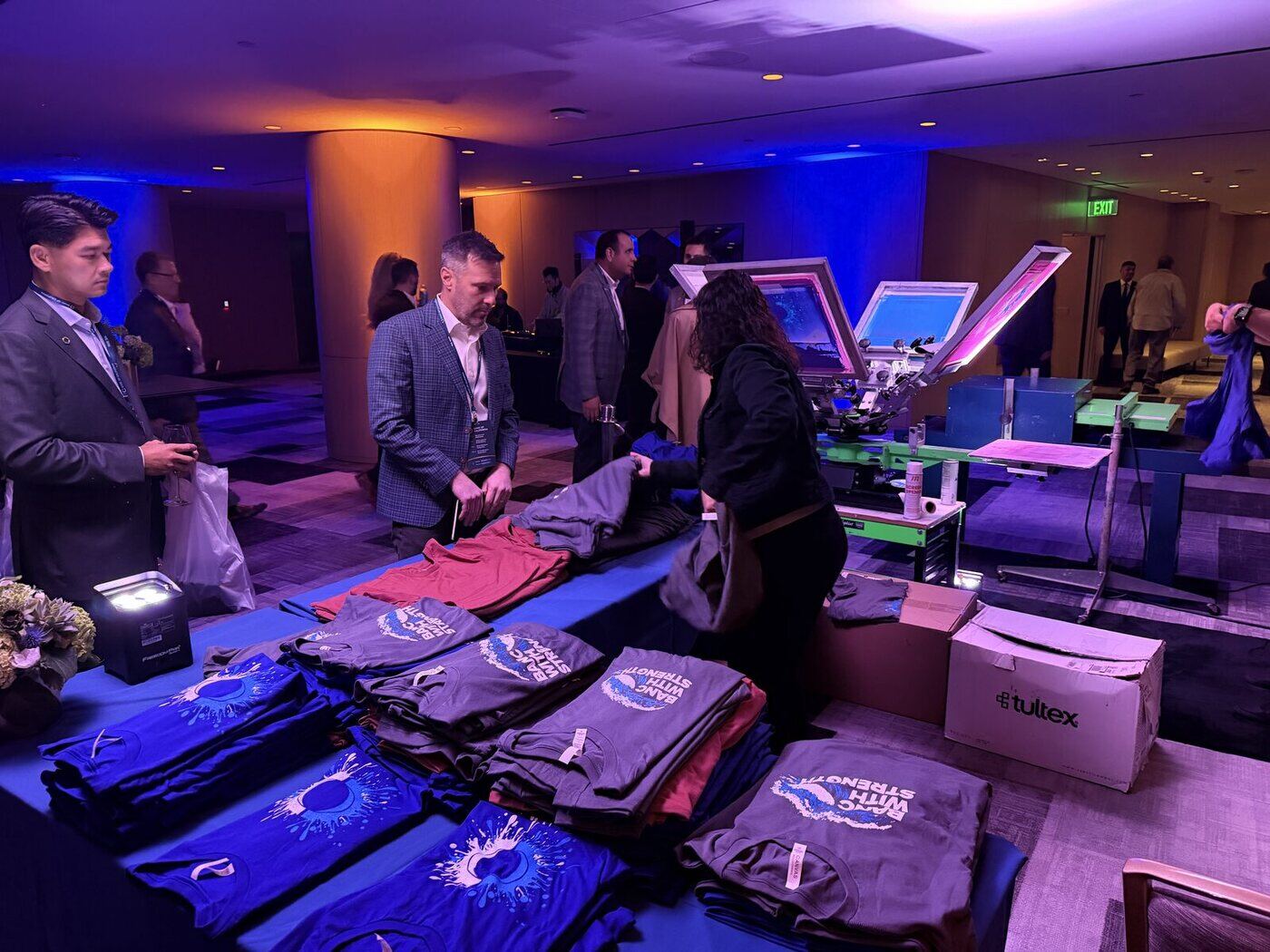
Capacity for a single release
Sizing itWatch parties concentrate demand harder than any other format we run, so the sizing method is different. You are not planning against an average hour. You are planning against one rush.
- Take the guest count and apply a take rate. A captive corporate list skews high, because everyone knows each other and nobody wants to be the only person not wearing one. Open or public crowds skew lower and are harder to predict.
- Assume most of that lands in the peak block. Not spread evenly across the evening. The forty-five minutes before start does the heavy lifting.
- Convert to lanes. A lane is one press plus one operator, and events commonly run two to four. Throughput is roughly linear in lanes, so this is the dial to turn — not wishful thinking about how fast a single press can go.
- Decide what happens if you are wrong. The graceful failure is a hybrid: pre-produce a batch for the confirmed list so the room is kitted regardless, and keep a live lane running for personalization and walk-ups.
Intake runs off a tablet queue: each guest entry becomes a numbered ticket, and tickets are distributed to whichever lane has the least pending work. That is what stops a busy station stacking up behind one slow press — and in a single-rush format it is the difference between a queue that clears and a queue that becomes the story of the evening. The full throughput reasoning is in how many jerseys per hour.
Sizing runs adult XS–3XL for guest-facing events, and inventory can be capped per size so a sold-out size disappears from the picker instead of being promised at the counter. On a watch party this matters more than usual, because the whole room is ordering inside the same twenty minutes and nobody wants to hear it at the front of the line.
The details that decide the night
Get these rightKeep the menu tight. Every choice a guest makes is a moment at the tablet. One garment colour and a fixed print location move a room visibly faster than an open menu, and nobody at a watch party has ever complained about not being offered a sleeve option. Names cap at about nine characters — worth mentioning in the invite if your crowd has long surnames.
Own the last ticket. Decide who announces that the queue is closing and how much warning is given. A station that simply stops has a knot of disappointed people around it at the exact moment the room should be cheering. One that calls a last ticket ten minutes out does not.
Go quiet for the moments that matter. If there are remarks before the broadcast, the presses stop. That should be a real cue with a named owner, on the run sheet alongside everything else.
Plan the surplus. Leftover garments are boxed and handed to your team at teardown, and they reliably turn into onboarding kits or prizes — a decent argument for ordering slightly over. Running out at a watch party is far more visible than having a box left. If the crowd is your own staff, our notes on employee appreciation events cover how sizing and naming conventions differ.