How many jerseys can you print per hour at an event?
We will give you a throughput figure in writing during scoping, for your garment, your menu and your lane count. What we will not do is publish one universal number, because anyone who does is quoting a best case you will not get.
Why the honest answer is conditional
The real variablesPress time is the part of this that is predictable. Almost nothing else is. Four things move a station's real-world hourly rate more than the machine does:
How many decisions a guest makes. Colour, size, print location, design choice, name, number. Each one is a moment at the tablet. A tight menu of three good options moves visibly faster than a menu of twelve, and the difference across a busy hour is substantial.
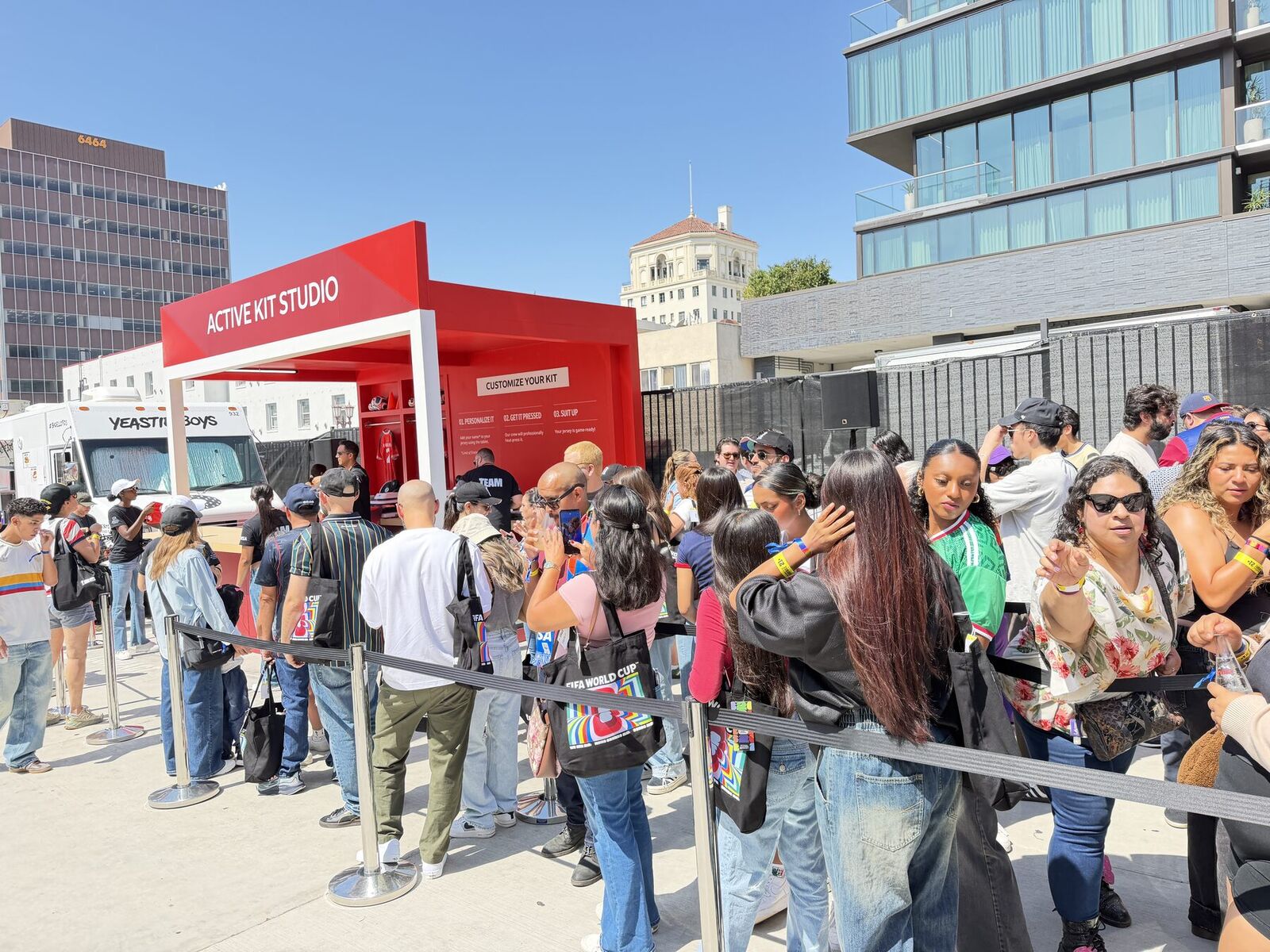
Whether guests arrive evenly. A conference releases its floor in twenty-minute bursts after sessions. A watch party dumps everyone at once ninety minutes before kickoff. A plaza activation trickles all morning and floods after lunch. The same station has three completely different effective rates in those three settings.
Lane count. One press and one operator is a lane. Two to four lanes is a common event build, and larger activations scale further. Throughput is roughly linear in lanes, which is why this is the dial we turn rather than trying to make a single press faster.
The garment. A lightweight tee and a structured jersey are not the same handling job, and a second print location is a second pass.
How the queue avoids a bottleneck
MechanicsIntake runs off a tablet. Every guest entry becomes a numbered ticket, and tickets are distributed across the press lanes by least-pending-work. Staff work from a queue board rather than from whoever happens to be standing in front of them.
This sounds like a small operational detail and it is the single most important one. Without it, the natural failure mode of a multi-press station is that one lane accumulates a backlog while another finishes early and waits. With it, the whole station drains at the rate of its combined capacity instead of the rate of its slowest lane.
It also gives you a real count at the end of the day. Every item that came off a lane came off a ticket, so the number of units pressed is measured rather than estimated. If you have to report on the activation afterwards, that is worth more than an impressions figure someone invented.
How to size it yourself, roughly
Planner methodYou can get most of the way there before you talk to anyone. Work in this order:
- Find the real window. Not the venue booking — the period guests are actually available and motivated. For a watch party that is the ninety minutes before kickoff. For a conference it is the sum of the session breaks.
- Apply a take rate. Not everyone participates. A captive corporate list skews high; open public traffic skews lower and is harder to predict.
- Find the peak, not the average. Divide by the number of usable minutes in your busiest block, not across the whole day. Staffing to the average guarantees a bad twenty minutes.
- Bring that number to us. We will tell you the lane count it needs and commit to it in the scope.
If the honest answer is that your window cannot absorb your guest count at any sane lane count, we will say so and suggest a hybrid — pre-produce part of the run for a known list, and keep the live station for walk-ups and personalization. That is a better outcome than a line that stalls during your only hour with the sponsor on site.