Home Guides Sponsor activation ideas
Sponsor activation jersey ideas that hold a crowd
A sponsor buys three things from a footprint: people stopping, people staying, and people remembering afterwards. A jersey station is unusually good at all three, and the reason is not the printing — it is that the guest has to wait for something with their own name on it.
Why it beats a spin wheel
The mechanicMost activation mechanics resolve instantly. A guest spins, wins a keychain, and is gone in forty seconds having formed no relationship with anything.
Personalization inverts that. The guest makes a choice, gives you a name, and then has a legitimate reason to stand near your brand until it is finished. That gap is the entire product. It is when an ambassador can have a real conversation instead of a transaction, when a demo gets watched, and when the guest starts thinking of the item as theirs before they hold it.
It also produces a takeaway that survives the weekend. Generic swag gets abandoned on a chair. A jersey with someone’s own name across the back gets worn, and everywhere it gets worn a sponsor mark goes with it. That is defensible in a post-event report, because the units are counted rather than modelled.
Merch Troop has run live merch stations for Riot Games, Sony, Coca-Cola, Hyundai and Dickies, and the pattern repeats: the queue is not the problem to be solved, it is the asset to be designed.
Six ideas worth stealing
Build variationsMake the number mean something
Numbers run one to three digits, and left to themselves most guests pick something arbitrary. Give them a prompt instead: the year they joined, their number as a kid, the floor they work on. It costs nothing, produces a better answer at the tablet, and turns a blank field into the conversation an ambassador can open with.
Put the sponsor on the sleeve, not the chest
The instinct is to make the logo enormous. Resist it. A guest wears a jersey that looks like their jersey and abandons one that looks like a billboard. Print location is configurable — back, front or sleeve — and a restrained sleeve or upper-back mark gets worn far more often than a chest slab.
Run a tiered offer
Not every guest needs the same thing. A base tier for general traffic and a premium tier for VIPs, partners or competition winners lets you spend where it counts. On the premium tier, guests can be texted when their jersey is ready instead of standing in line — which spreads your peak and makes the wait feel like hospitality.
Pair a slow station with a fast one
A jersey takes longer per guest than a cap or a patch. Putting a faster station alongside the jersey lane gives waiting guests something to do, absorbs overflow when the queue spikes, and quietly doubles the reasons to approach the footprint. It is the most reliable fix for a line that looks intimidating from across a hall.
Design the queue as a stage
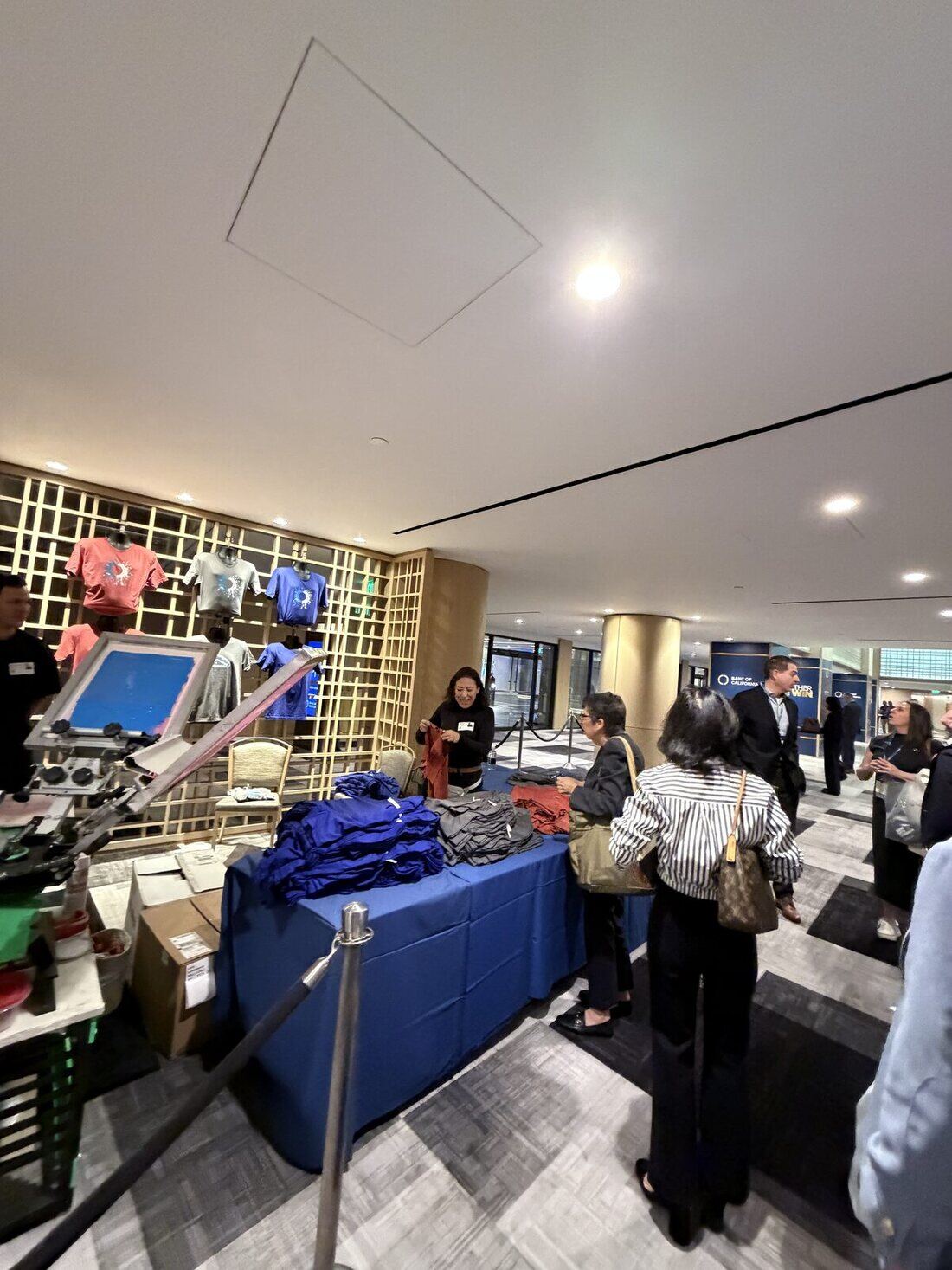
Stanchions, a visible three-step board and a clear direction of travel change how a line feels. Guests who understand the process wait more patiently than guests standing near a table. It also gives you a captive row of people facing whatever you put in front of them — a screen, a product wall, a demo.
Give the crew a script
The press crew is the most-photographed part of the footprint and speaks to more guests than anyone else you hired. Tell us the tone — loud and hyping a crowd, or quiet and efficient at a corporate evening — and brief us on the one sponsor line you want said out loud.
Dwell time, opt-ins and recall
What to reportIntake runs off a tablet, and every guest entry becomes a numbered ticket. That is an operational detail with a reporting side effect: at teardown you have a measured count of units produced rather than an impressions figure invented in a spreadsheet. If your sponsor report has to survive procurement scrutiny, that matters.
The tablet is also the natural place for a data capture if your programme includes one. Keep it to a single field beyond what production needs — the moment personalization starts feeling like a form, the queue slows and the mood changes. One question, answered while they are already typing their name.
For recall, the honest framing is this: the impression is not made in the footprint, it is made every subsequent time the guest puts the jersey on. Spend your argument on making the garment genuinely wearable — good blank, restrained branding, a size curve that fits the crowd — not on maximising logo area.
Briefing us properly
Before you scopeFour answers get you an accurate build rather than a generic one. What is the footprint, and is it indoor, tented or open? What is the traffic pattern — all-day trickle, or three savage rushes tied to a schedule? Who is the audience, and do they share an identity that makes a jersey make sense? And what does the sponsor need to be able to say afterwards?
That last question changes the build more than people expect. A sponsor optimising for volume wants a narrow menu and more lanes; one optimising for quality of conversation wants fewer, longer interactions and a premium tier. Decide which you are buying before anyone prices it. If the footprint is outdoors, read our outdoor station answer first — power and cover shape the layout before aesthetics do.
And if the crowd has nothing in common and no reason to want a sports garment, we will say so. The same crew runs caps, patches, embroidery and engraving.