Can you print jerseys outdoors?
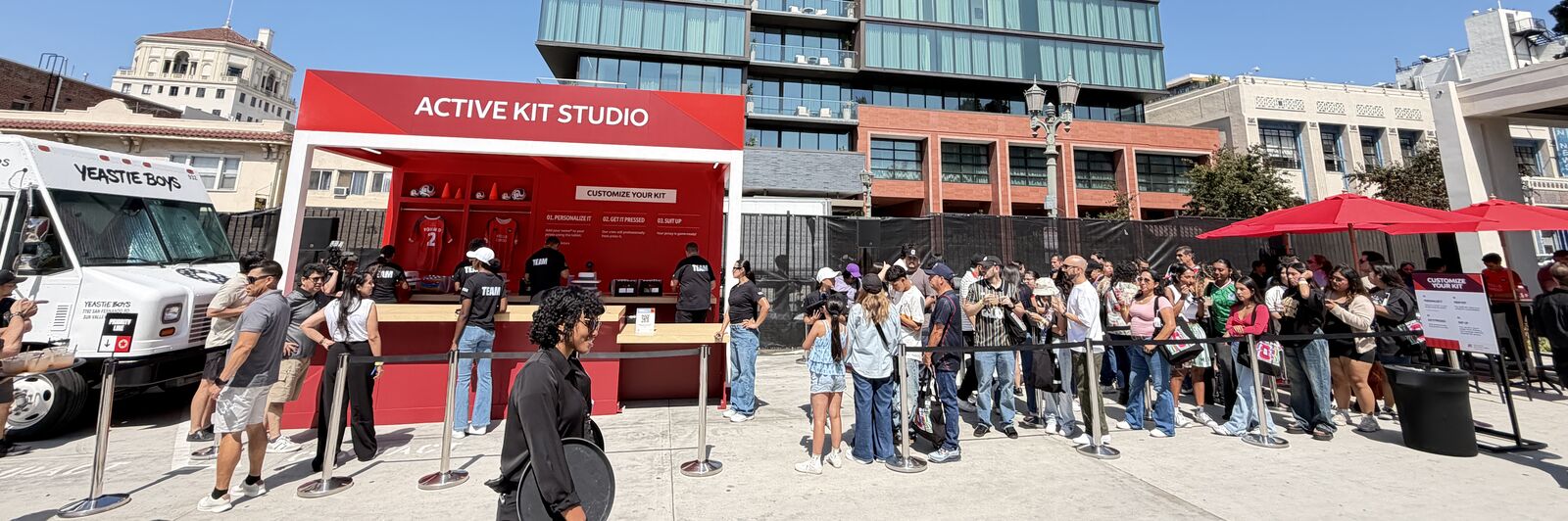
Yes. Our crews have run this format at outdoor sport activations with hundreds of guests queuing, including a red kit studio build with locker bays, tablet stations and a pressing crew working under cover. Outdoors changes the engineering, not the guest experience — provided the engineering gets planned rather than discovered.
What actually changes outside
The honest listA heat press does not care whether it is indoors. What cares is everything around it: the circuit it is plugged into, the surface it stands on, the air moving across it, and the finished garments waiting to be handed over. Take those four seriously and an outdoor build behaves much like an indoor one.
The failure mode of outdoor activations is rarely the printing. It is a generator sized for lighting rather than presses, a tent with no side walls on the windward edge, or a beautifully specified footprint sitting on grass that turned to mud overnight. Every one of those is a planning conversation, and every one is cheaper to have now than at 7am on the day.
We ask the same first question about every outdoor date: is there a hard structure or a tent, and is it up before we load in?
Power is the whole conversation
Circuits & generatorsHeat presses pull real current, and they pull it in cycles rather than steadily. That matters because a generator sized on average draw will sag when several lanes cycle together, and a brown-out mid-press costs you the garment as well as the minute.
Where a venue has permanent power near the footprint, use it — a plaza, a stadium concourse or a parking structure often has more capacity than anyone remembers. Where it does not, you need a generator specified for the station rather than shared with the sound system, the lighting rig and a coffee cart. We give you the circuit count in writing during scoping so you can hand a real number to whoever is ordering power, instead of a shrug.
Two practical notes. Distance matters — long runs of undersized cable lose voltage, and voltage loss shows up as inconsistent presses rather than an obvious fault, so it gets blamed on the operator. And cable management outdoors is a safety item rather than tidiness: anything crossing a guest path needs matting, and the queue route should be designed to cross as little cable as possible in the first place.
Heat, humidity, wind and shade
ConditionsAmbient temperature
Presses radiate. Add a hot afternoon and the crew area becomes the hardest place on site to work, which slows a lane long before the equipment complains. Shade over the work area and airflow behind the tables are throughput decisions, not comfort ones.
Humidity & marine layer
Coastal mornings put moisture into garments and into stock sitting in open air, and damp fabric behaves differently under a press. The fix is boring and effective: keep blanks boxed and covered until needed, and stage only what the next stretch of queue will consume.
Wind
The underrated one. Wind lifts transfers off a staging table, flaps signage, and steals heat from the platen between cycles. Side walls on at least the windward edge, weighted stock bins and clipped signage handle it. A fully open four-sided tent on an exposed site is a bad plan.
Direct sun on the guest
Shade the queue, not just the crew. A line standing in full sun shortens itself — people leave — and that shows up in your unit count. Orientation matters for photos too: guests holding a jersey up with the sun behind them photograph badly, and that is free to fix at layout stage.
Flooring, footprint and the weather call
ContingencyFlooring. Hard, level, dry. Paving, concrete and event flooring are all straightforward. Grass and dirt are workable with matting or a raised floor and become difficult without it — tables rock, cable trays sit unevenly, and one overnight rain turns the whole footprint into a liability. If the site is turf, put flooring in the budget early rather than debating it later.
Footprint. Outdoors usually wants slightly more room than the same build indoors: cover has to overhang the work area, stock needs a dry corner, and the queue needs a defined route rather than a vague direction. A two-lane build is comfortable in roughly a ten-by-ten indoors; outdoors, plan on the tent being a size up from what the tables alone would suggest. The rest of the requirements are the same as any build — the detail is on our on-site requirements page.
The weather call. Decide in advance who makes it, at what time, and what the alternative is. Light rain under a properly walled tent is a non-event. Sustained wind, lightning or standing water is not, and by then it is a safety decision rather than a printing one. The useful version of a contingency is not “we will see how it looks” — it is a named person, a named cut-off time, and a covered fallback location that somebody has actually walked.
If the forecast is genuinely unstable, consider the hybrid: pre-produce part of the run so the takeaway exists regardless, and keep the live lane for personalization if conditions hold. Guests who came for a jersey still leave with one, and the live element stays a bonus rather than a single point of failure.
What we need from you is early honesty about the site — surface, cover, power source and fallback — because those four answers shape the quote more than the guest count does. If the site is still being chosen, our lead time answer covers what else is worth locking early.