Questions to ask a jersey printing vendor before you book
Live printing looks similar in every proposal deck. It stops looking similar the moment you ask specific questions, because the answers separate operators who have run a busy line from suppliers who happen to own a press. Here is the list we would want a planner to run on us.
Throughput and staffing
Section one“How many units will you commit to in my window, in writing?” Note the two conditions. A vendor quoting a headline hourly rate without knowing your garment, menu or arrival pattern is quoting a best case. One willing to put a number in the scope has done the arithmetic against your event.
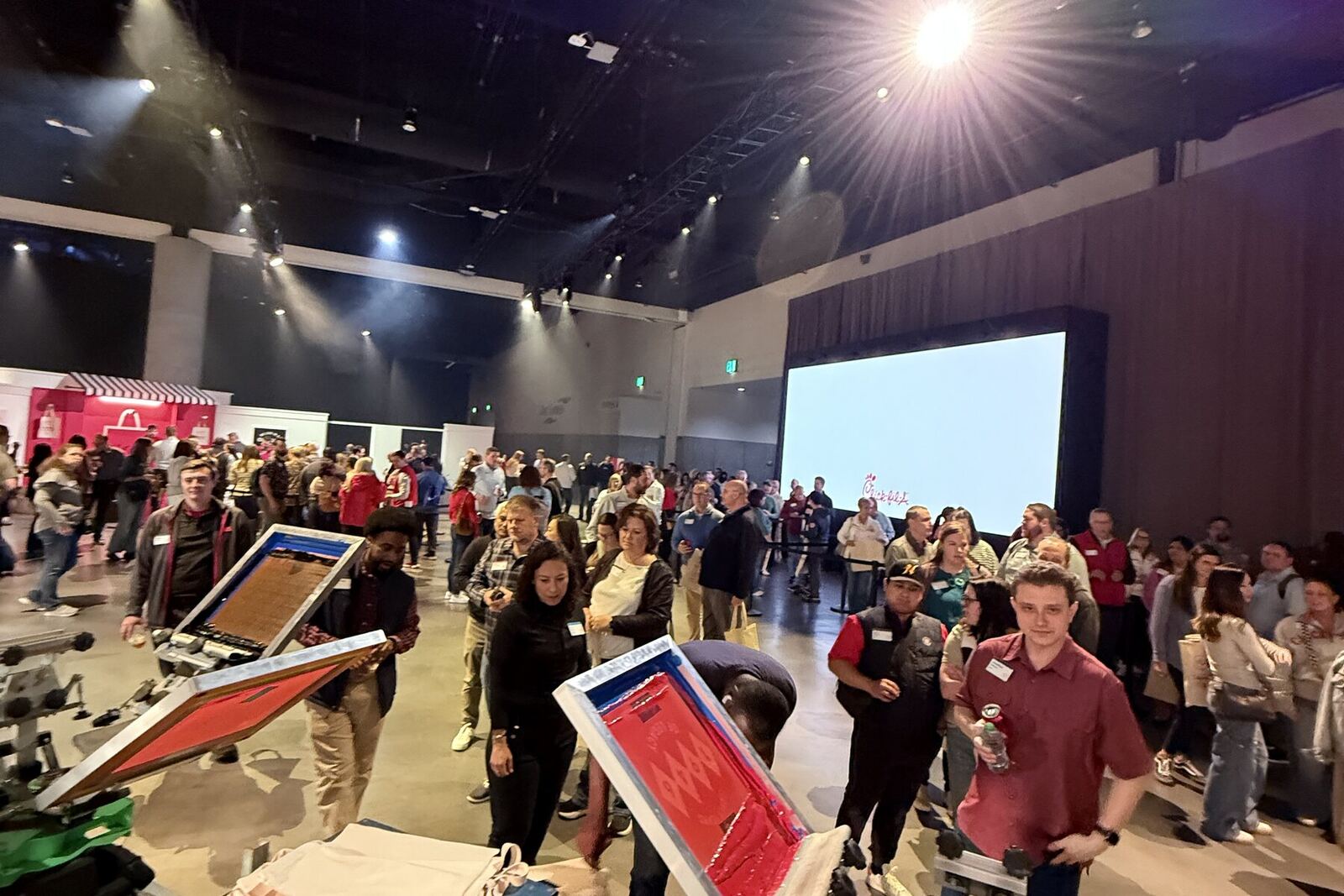
“How many press lanes, and how many people?” A lane is one press plus one operator. Two to four lanes is a common event build. If a vendor is vague about the ratio, ask who is watching the whole station — someone needs to run the board rather than press, or nobody notices the queue growing until a guest complains.
“How does the queue actually work?” The answer you want involves tickets. Tablet intake that turns each guest entry into a numbered ticket, distributed across lanes by least-pending-work, is what stops a multi-press station stacking up behind its slowest lane. “People line up and we work through them” describes a bottleneck.
“What do you do if we are running behind?” Good answers are specific and small: relax a menu option, call a size, move someone from staging to intake for twenty minutes. And tell the planner while there is still time to act.
Garments and artwork
Section two“What method are you using, and why?” Modern jerseys are cut from slick, textured and mesh polyester. Full-colour DTF transfers with a heat press are what reliably works on that fabric at speed. Twill, tackle-twill and embroidery give a heritage look but are slower per unit and suit a pre-produced batch or a small premium tier rather than a live queue. A vendor should explain that trade-off unprompted.
“Can we supply our own garments?” The answer should be yes. Teams, leagues and internal clubs often already own the kit and need only names and numbers applied. Ask what they need to confirm it — a photo of the fabric before the date is the right answer, not a shrug on the morning.
“What is the character limit, and where does the guest find out?” Names cap at about nine characters and numbers at one to three digits, because letter spacing across a jersey back falls apart past that. The limit is not the interesting part — where it is enforced is. It should be enforced at intake, so nobody gets bad news at the front of the line.
“What happens when a size runs out?” Inventory should be cappable per size so a sold-out size disappears from the guest picker rather than being promised and withdrawn. Ask whether guest-facing sizing runs the full adult XS–3XL.
“Who owns artwork prep, and what file do you need?” Get the format and the deadline in writing, and name your approver the same day. Art is the line that inflates quietly while a logo sits in review.
Logistics, paperwork and the day itself
Section three“What do you need from my venue?” You want numbers, not adjectives: square footage, table count, and how many dedicated circuits. Heat presses pull real current, and a shared strip off a coffee station is not a power plan. Convention centres charge far more for power ordered on the day than in advance, so a vendor who gives you the circuit count late has cost you money.
“What is your load-in and teardown?” Ask for actual hours so you can book the dock and the freight elevator, and mention union or badging rules early to see whether they blink.
“Can you produce a certificate of insurance for my venue?” If this question causes friction, that is your answer. Most venues have their own wording and their own deadline, both earlier than people expect.
“Who is my contact during service, and what is their mobile?” During an event nobody reads email. You want a crew lead’s number and someone senior on the floor.
“How will I know what actually happened?” Ticketed intake means the unit count at teardown is measured rather than estimated. If you report internally, ask before you book rather than after.
“What happens to leftover stock?” It should be boxed and handed to your team, not quietly loaded into a van.
“What does travel cost, and how far ahead do you need booking?” Ours is $0 within Orange County, LA and San Diego and $900 beyond, and our lead time answer sets out the booking windows. Any vendor should be able to state both plainly rather than folding them invisibly into a single number.
Answers that should worry you
Red flagsA single mystery number
A quote that is one figure with no breakdown cannot be defended internally or trimmed intelligently. You want event hours, blanks, art prep, staffing and travel as separate lines — the budget page sets out the inputs.
A guaranteed rate with no questions asked
If nobody has asked about your arrival pattern, menu size or garment, the number you were given is a brochure figure. It will be right for someone. Quite possibly not you.
“Yes” to everything
A jersey station is wrong for some briefs — formal evenings, very small headcounts, crowds with no shared identity, windows under about ninety minutes. A vendor who never steers you elsewhere is an order-taker rather than a partner.
Vagueness about who shows up
The crew is the product. Ask whether the people quoting are the people coming, how they get briefed on tone, and who runs the board on the day while everyone else is pressing.