How far in advance should we book jersey printing?
Four to six weeks is the honest general answer for a staffed station at a corporate event. The useful answer is narrower, because the window is set by whichever of five inputs is slowest — and on most bookings the slow one is artwork, which is entirely inside your control.
The windows, by scenario
Straight answerThese are the brackets we actually work in. None of them is a policy — they are what the calendar looks like once blanks, art and crew scheduling are laid end to end.
- Unhurried, every option open8–10 weeks
- Standard corporate booking4–6 weeks
- Tight, but routine for us2–3 weeks
- Short notice, conditions apply7–14 days
- Client-supplied kit, local, simple artA few days
The gap between the top bracket and the bottom one is not effort, it is optionality. At eight weeks you can choose any garment style, any colour and any size curve. At ten days you take what is in stock, and the artwork gets approved on the first pass or not at all. Both produce a good station. Only one lets you be picky.
Whether a jersey station is the right format at all is a call worth making early too. Our event type notes cover where it lands well and where a cap or patch station serves you better.
The five things that eat the calendar
What moves your dateArtwork. This is the one that slips. A clean vector file with a named approver is a short, cheap job. A logo still sitting in legal review, or one that arrives as a screenshot pulled from a slide deck, becomes a rebuild — and rebuilds queue behind other events. If you take one thing from this page, make it this: name the person who signs off the art on the day you sign the contract.
Blanks sourcing. Stock jersey styles in common colours move quickly. A specific colour, a specific brand, a full XS–3XL curve at volume, or a decorated blank rather than a plain one all add days — and they add more days in the weeks when the whole industry is buying. Client-supplied garments remove this input completely, which is why teams and leagues that already own their kit can book far later than a company ordering fresh.
Guest count. Two hundred guests and two thousand are not the same procurement problem. Higher counts mean more units, more sizes, more lanes and more crew — and crew is scheduled against other events, so a four-lane build on a Saturday in a busy season needs more notice than a two-lane build on a Tuesday.
Travel. Orange County, Los Angeles and San Diego are same-week feasible more often than not. Las Vegas is a regular run and wants a little more. Anything nationwide means freight, a vehicle plan and crew travel, and those need real lead time rather than heroics.
Venue paperwork. Convention centres and stadiums are the quiet deadline nobody puts on the plan. Certificates of insurance, badging, dock windows, union labour rules and advance-ordered power all have their own cut-offs, usually earlier than yours. Ask your venue contact for their vendor deadline the week you book us.
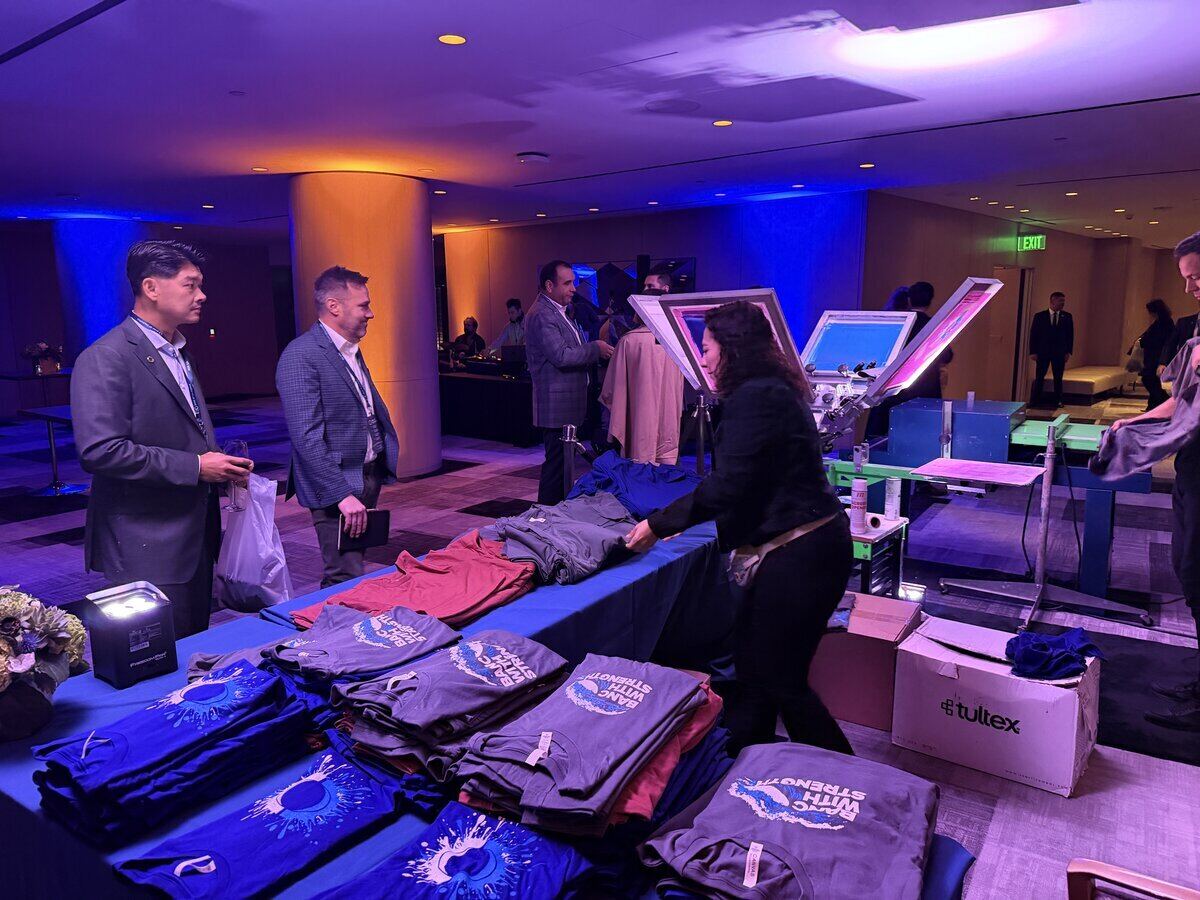
What can still be done at short notice
Late bookingsYou supply the kit
If the jerseys already exist, the longest input disappears. Names and numbers applied to garments you own is the most last-minute-friendly version of this service. Send a photo of the fabric and we will confirm the application in advance.
Local dates
A station inside Orange County, LA or San Diego avoids freight and travel planning entirely. Crew availability becomes the only real constraint, and that is a phone call rather than a process.
Art that is already clean
Vector, correct colours, one approver, nothing pending in legal. If the file is genuinely production-ready, art prep stops being a schedule item and becomes an afternoon.
A narrower menu
One garment colour, one print location, a fixed size curve. Cutting the option list shortens procurement and speeds the lane on the day — a rare decision that helps twice.
Call before you assume the date is gone. The worst outcome of a short-notice enquiry is a straight no on the phone, which costs you five minutes. We would far rather tell you honestly that ten days is not enough for a fresh two-thousand-unit build than take the booking and quietly under-deliver on it.
How to use the time once you have booked
Between signing and doorsBooking early only helps if the weeks get used. In practice the sequence that keeps a build calm looks like this:
- Immediately. Confirm the guest window — not the venue booking, the block when guests are genuinely available. Lane count is sized against that.
- Straight after. Send artwork and name your approver. Ask your venue for their vendor deadlines and power cut-off in the same email.
- Mid-window. Lock the size curve and garment colour. Decide whether guests choose the print location or you fix it for the whole event; fixing it removes a decision from the tablet and visibly speeds a busy hour.
- Final fortnight. Share the run sheet, confirm load-in and the dock window, and settle who calls the last ticket. Our run-of-show guide covers the cues that need a named owner.
One more note on names. The practical limit is about nine characters, and numbers run one to three digits. Longer names hit letter-spacing problems across a jersey back — the word crowds the number and stops reading from across a room. Worth knowing early if your event has a naming convention in mind.
And if the honest answer turns out to be “further ahead than we have,” there is usually a hybrid: pre-produce for the known list, keep a live lane for walk-ups. For plenty of events that is the better build anyway.