Home Guides \g<1>Youth tournament jerseys\g<2>
Live jersey personalization at youth sports tournaments
A youth tournament is a merch format unlike any other. The crowd is captive for two or three days, every family wants the same thing, and the demand does not arrive in one rush — it arrives in waves shaped by the bracket. Plan for the bracket and the station works. Plan for an average hour and it does not.
Read the bracket, not the clock
The demand curveThe instinct is to staff evenly across the hours the venue is open. That is the wrong shape. Tournament merch demand is driven by three specific moments, and they are predictable enough to schedule around.
Saturday morning, before first games. This is the largest single block and the one most stations underestimate. Families arrive early, they are not yet emotionally invested in a result, and the kids are bored. Roughly a third of the weekend's volume lands here.
Between-game gaps. Steady, forgiving, and the easiest work of the weekend. Families with a two-hour window between pool games will browse properly and make considered choices.
After elimination, and after the final. Two very different waves. Teams that just lost buy on the way out and buy fast — it is the last chance and everyone knows it. The championship wave is smaller in number but higher in value, because a title jersey is a keepsake and price sensitivity drops.
The scheduling consequence: put your heaviest staffing on Saturday morning and again in the final elimination block, and accept a quieter middle. A station staffed flat across three days will have a queue it cannot clear at 8am and idle presses at 2pm.
Where the station goes
Venue placementTournament venues are usually complexes rather than rooms, and the placement rules are different from an indoor event. Put the station between the parking lot and the fields or courts, on the path everyone walks anyway. Families should pass it on the way in, when they have time, rather than having to go looking for it.
Avoid the temptation to set up beside the main field. It sounds right and it is not — parents at the field are watching the game, and anyone who steps away to browse feels they are missing something. Proximity to the concessions area works far better, because a line beside a line is normal and the two feed each other.
Shade matters more than anything else outdoors. A station in direct August sun loses browsing time, the crew degrades, and heat presses behave differently. A 10x20 under cover with airflow is worth more than a bigger footprint in the open. Power is the other constraint: confirm what the venue can actually deliver at your location rather than what the site map claims, and have a generator plan for field complexes where the nearest real circuit is a concession trailer.
Define the queue direction with stanchions or tape. At youth events the line includes children, strollers, and equipment bags, and an undefined queue sprawls across a walkway within twenty minutes.
Names, numbers, and the roster problem
The dataThe single biggest difference between a youth tournament and any other jersey job is that you are printing hundreds of distinct names, and you do not control the source data.
Get rosters in advance wherever possible. Tournament organizers usually have them, and a spreadsheet of team names, player names, and numbers loaded into the queue in advance removes the slowest step at the counter. When a parent can say "Riverside 12U, number 8" and the name auto-fills, transaction time drops by more than half.
Where rosters are not available, run manual entry with a confirmation screen the customer reads back. Names get misspelled at the counter far more often than people expect, and a jersey with a misspelled surname is a remake, not a complaint you can talk your way out of.
Three policies worth setting before the weekend starts, in writing:
- Character limits. Around nine to twelve characters depending on the jersey width and the font. Publish it, because long surnames are common and a parent who finds out at the counter is a parent having a bad morning.
- Who may be named. Decide whether non-players — siblings, parents, "Team Mom" — can be printed. Most tournaments allow it and it is meaningful incremental volume, but the crew needs a rule rather than a judgment call.
- Nicknames and screening. Free-text entry at a youth event needs a filter and a human check. This is not hypothetical; it comes up at essentially every open-entry event.
Keep a remake buffer of blanks in the most common sizes. Misprints happen, and the difference between a good weekend and a bad one is whether you can fix one in ten minutes.
Sizing, staffing, and what to bring
Running itSizing skews small and it skews wide. Youth tournaments need genuine youth sizing — YS through YXL — alongside adult sizes for parents, coaches, and siblings. A common mistake is bringing an adult curve with a token handful of youth mediums. Expect roughly half your volume in youth sizes at a 10U-to-14U event, shifting toward adult as the age brackets go up.
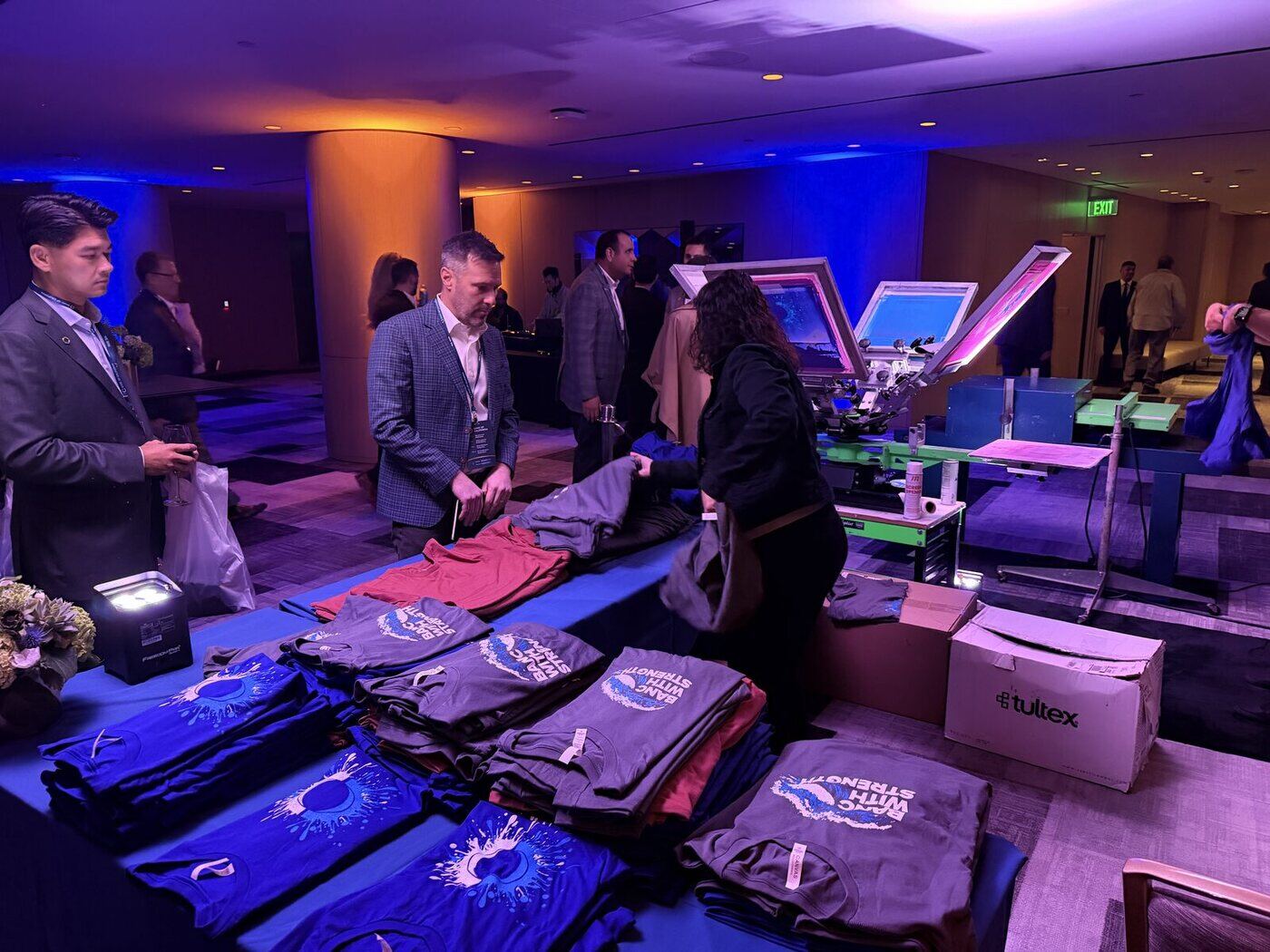
Staff for entry, not for pressing. The press is rarely the constraint. The constraint is order entry, name confirmation, and handing the right jersey to the right family. A lane is one press plus one operator, and at a tournament we generally add a dedicated intake person in front of the lanes on Saturday morning specifically to keep the queue moving.
Use claim tickets aggressively. Nobody at a tournament wants to stand and wait while their kid's game starts. A numbered ticket and a pickup window converts a wait into an errand, and it is the single most effective throughput tool at a multi-hour event.
Team bulk orders are a separate lane. A coach ordering fifteen jerseys at once will block a retail queue completely. Take those as an order to be produced in a gap, with a pickup time, and keep the walk-up lane clear.
Plan the leftovers. Blanks carry over to the next event; personalized jerseys do not. Produce personalized pieces to order and only pre-produce generic tournament-branded stock, in conservative quantities.
Frequently asked questions
Straight answersStraight answers to what organizers ask most.
How much lead time do you need for a tournament?
Two to three weeks is comfortable for artwork, blanks, and staffing. If team rosters are available, getting them a week out is what makes the difference at the counter — it is the cheapest speed improvement available to you.
Can families order for a team that is not theirs?
Technically yes, and it happens with grandparents and family friends constantly. It is worth deciding in advance whether you print any requested team name or restrict to registered rosters, because the crew will be asked within the first hour.
What happens if a jersey is misprinted?
We keep a remake buffer of blanks in the common sizes and redo it on the spot. That is why the buffer exists — at a tournament there is no second chance to hand someone their jersey, because they will be on the road by evening.